The Race Programme Before the Results Sheet
A race programme helps you track the event order, identify entrants and understand local traditions, so you can follow the day with confidence.
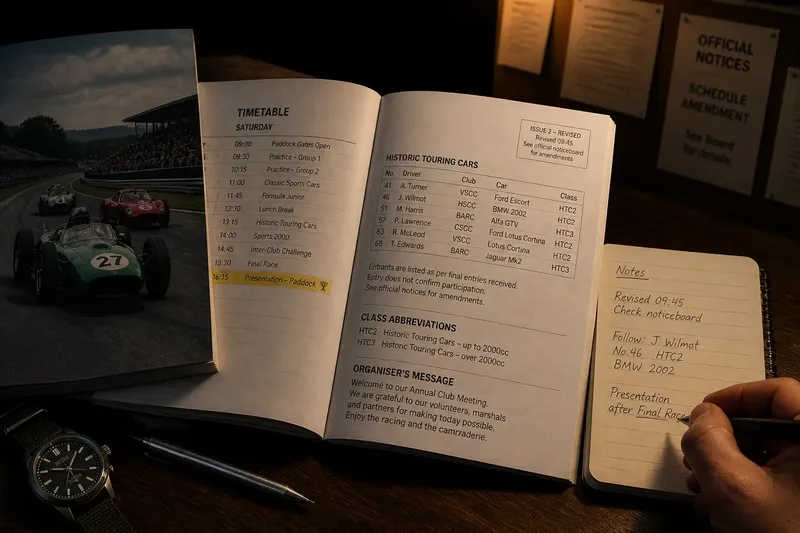
A race programme is easiest to use when you first establish what it covers and whether its information is current. Before following the schedule or entrant list, check the event details, issue status and any official updates; that gives you a sound basis for reading the rest.
Check the programme’s scope and current status
Start with the cover and front matter. Find the event name, venue, date and organiser, then look for wording such as “provisional”, “revised” or “final”. A provisional schedule may change, while a revision note can identify which version you are holding.
Check for an issue date or amendment notice, and look for the event organiser’s official noticeboard or information channel. On arrival, compare the printed schedule with any current announcements. If they conflict, use the latest official information and make a note of what changed.
Keep the programme’s scope in view, too. It may cover one competition, a series of races or a wider gathering with ceremonies and presentations. A welcome note or organiser’s message can explain the event’s purpose and point out information intended for competitors or spectators.
Read the schedule as a sequence
Find the contents page or timetable and identify how the events are named. Races may be grouped by class, category or format, so use the programme’s labels rather than guessing the running order from the length of an entrant list.
Mark the event you want to follow, then check what comes before and after it. The surrounding entries may show where a ceremony, interval or presentation fits. Treat the schedule like a paper map: marking your destination makes the route around it easier to understand.
If a class name or format is unfamiliar, look for a glossary, organiser’s note or class description. If the programme does not explain it, write down the term and ask an event steward or check an official notice when you arrive.
Use entrant lists to identify people and teams
Read the headings above an entrant list before scanning individual names. They may identify a class, team, club, vehicle or other category. Note the identifier and class alongside the name you are following; similar names and abbreviated club titles can be easy to confuse.
An entry shows planned participation, not a confirmed start or result. If you want to know whether an entrant is still expected, check the event’s current official information. For the recorded outcome, consult the results sheet after the event.
Say you are attending a club meeting and two drivers share a surname. You note the class and car number beside the driver you want to follow, then compare those details with the current noticeboard on arrival. If the noticeboard shows an amendment, you follow that update; otherwise, the matching details help you identify the right entry.
What should you check before relying on a programme?
How do you tell whether the schedule is current?
Look for an issue date, revision note or wording that calls the timetable provisional. Compare it with current official amendments at the venue, and follow the latest notice if the printed order differs.
What do entrant-list abbreviations mean?
Check for a key or explanation near the list, then consult the class notes if needed. If the abbreviation remains unclear, ask an organiser or steward rather than assigning it a meaning from context alone.
Can a programme confirm who will start?
No: it records planned entries, which may change before or during the event. Check current official information for amendments and use the results sheet for recorded outcomes.
Why does a programme include material beyond race details?
Welcome notes, club profiles, sponsor acknowledgements and presentation details can explain how organisers and participants mark the occasion. Read the wording closely; a club affiliation, sponsorship and dedication do not all signify the same relationship.
Read the notes for clues about local customs
Once you can follow the timetable and entries, look at the material around them. An organiser’s message may explain why a class is included or describe the work of volunteers. A club profile can place the meeting in its local context, while a presentation note can show what the event chooses to recognise.
Use the programme’s own wording to interpret repeated names and acknowledgements. A sponsor may support the event, a club name may identify an entrant’s affiliation, and a dedication may express a connection held by organisers or participants. Avoid treating these mentions as interchangeable.
These notes also give you useful questions to ask. You might ask a steward how a class fits into the day or ask a club member about a tradition you have just read about. That lets you join the conversation without pretending to know customs you have not encountered.
Keep notes that distinguish print from updates
Mark details you may want to remember, and keep your own observations separate from the printed information. If the schedule changes, record the official amendment rather than altering the original entry without explanation.
- Check that the event name, venue and date match the meeting you attend; if they do, use the programme for that event, but if they do not, ask an organiser for the correct information.
- Check whether the cover or timetable says provisional or revised; if it does, compare it with official updates, but if no status is shown, verify the schedule on arrival.
- Check the issue date against the latest official notice; if a newer notice changes the order, follow it and note the amendment, but if there is no newer notice, keep the printed order as your reference.
- Check that the entrant’s name, class and identifier agree; if all three match, use them to recognise the entry, but if any detail differs, check the current entry information before assuming it is the same person or team.
- Check whether an abbreviation has an explanation in the programme; if it does, use that definition, but if it does not, ask a steward rather than guessing.
- Check whether a ceremony or presentation appears in the schedule; if it does, mark its place in the day, but if it does not, look for an official announcement before relying on an informal assumption.
- Check whether a note is a printed detail or your own observation; if it is printed, preserve its wording, but if it is your observation, label it as a personal note.
Imagine you attend a meeting with a printed schedule that lists a presentation after the final race. You check the cover and see that the programme is marked provisional, then compare the timetable with the venue’s official noticeboard. The board moves the presentation earlier, so you mark that change separately; you then note that it recognises volunteer work, distinguishing the programme’s printed purpose from your own observation of the updated order.
Use the programme and results sheet for different purposes
The programme introduces the planned order, expected entrants and language used by the organisers. The results sheet records outcomes. Keeping those roles separate helps you avoid treating an entry as a confirmed start or an original timetable as a live update.
For a race programme, check its scope and status first, then follow the schedule, identify the entries you care about and read the notes that explain local customs. Keep official changes distinct from the printed version; that way, your copy remains useful both as a guide to the day and as a record of what organisers chose to include.